Stadium Journey's Ontario Hockey League Arena Rankings 2026


The 2025-26 Ontario Hockey League season seemed to bring as much drama off the ice as there was on the ice. At the beginning of January, the league was rocked with the news that longtime Commissioner of the OHL and President of the CHL, David Branch, had died. Rumours of expansion were abound with the belief that the USHL teams from Muskegon and Youngstown were headed to the OHL. This would turn out to be not the case as it is believed that USA Hockey blocked these moves. Expansion is still in the forefront for the league as some neutral site games were announced for Cornwall in the 2026-27 season. It was also announced that the Guelph Storm will be hosting the 2027 Memorial Cup.
The Kitchener Rangers were the story of this season. The Brantford Bulldogs were the best team during the regular season with 106 points. The London Knights had the best attendance once again, averaging 9,051 fans per game. However, it was the Rangers running roughshod through the playoffs to take the J. Ross Robertson Cup as OHL Champions, their fifth. The Rangers will be heading to Kelowna to represent the OHL in the Memorial Cup.
Marek Vanaker of the Bulldogs scored 47 goals while the Saginaw Spirit’s Nikita Klepov tallied 97 points. Ryan Fetterolf of the Ottawa 67’s was the top goaltender with a 2.07 GAA and .923 save percentage, winning the Jim Rutherford Trophy as goaltender of the year. The Rid Tilson Trophy for the Most Outstanding Player went to Sam O’Reilly of the Kitchener Rangers.
The annual OHL rankings at Stadium Journey are based on the FANFARE metric used on the website, where a number of different writers assess the hockey experience based on the categories of Food, Atmosphere, Neighbourhood, Fans, Access, Return on Investment and any extras that the writers experienced. The stakes are high, with an average grading of 3.59 being earned out of a possible perfect 5.0.
This list is just an amalgamation of a number of opinions, and may not be in agreement for all. Please let Stadium Journey know your opinions on our various Social Media outlets. How is your list different from ours? What do we have right? What do we have wrong?
Without further ado, Stadium Journey is proud to present the 2025-2026 Rankings of the Ontario Hockey League Experiences.

Dave Cottenie - The home for the Steelheads is CAA Centre. The city owned arena opened in 1998 and has a capacity of 5,000. It is an appropriate home for OHL hockey as it housed the Brampton Battalion from 1998 to 2013, before they moved to North Bay. A familiar story for OHL hockey in the GTA is once again brewing, low attendance and an uncertain future.

Dave Cottenie - When Peter Karmanos sold the Plymouth Whalers of the Ontario Hockey League to the IMS Hockey Corporation and Rolf Nilsen there were a number of eyebrows raised. There are more than enough doubters when it comes to the Firebirds viability in Flint, but IMS is chugging along and they want everyone to get behind and Believe in Flint.

Dave Cottenie - Saginaw provides a decent hockey experience for Junior Hockey. The Dow Event Center is one of the nicer OHL venues from the exterior. The Atrium can be found on the north side of Johnson Street and offers a warm, welcoming feeling for fans coming out of the cold, Central Michigan winter. Glassed in and spacious, the Atrium is a great place to meet friends before the game and also houses security and the ticketing windows. The upper rotunda features hanging banners of significant, former Saginaw Spirit players. These include Ryan McDonough, Jack Combs, Josh Shalla, Vince Trocheck, Dylan Sadowy, Brandon Saad, T.J. Brodie, Tom Pyatt, Eric Locke, Brad Walch, Patrick McNiell and Jake Paterson.

Dave Cottenie - On the banks of Georgian Bay sits the smallest market in the Ontario Hockey League. In 1989, the Guelph Platers, who had been in Guelph since 1968, made the move north to the Grey-Bruce area of Ontario. The Owen Sound Platers were to be sold to a businessman out of town which would require relocation. The “Super Six,” would come together to purchase the team and keep them in Owen Sound. Brian Johnson, Dr. Robert Severs, Fay Harshman, Frank Coulter, and Peter and Paul MacDermid, a group of local business owners, would keep that can-do attitude alive in Owen Sound and the Attack have remained viable and competitive in the Ontario Hockey League. The hard work culminated in the Attack’s 2011 J.Ross Robertson Cup as OHL Champions and a berth in the Memorial Cup.
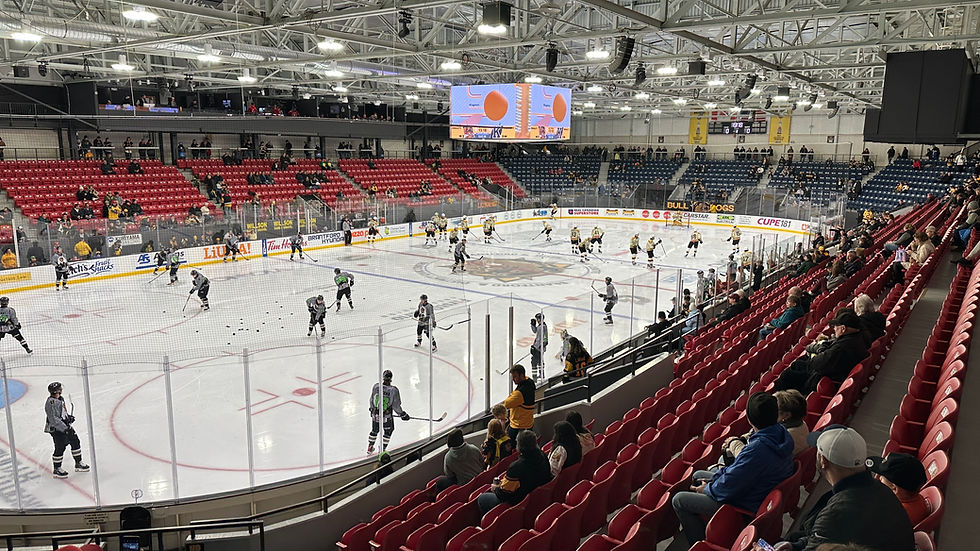
Dave Cottenie - When the Hamilton Bulldogs found they would be homeless for two years as the FirstOntario Centre undergoes renovations, owner Michael Andlauer found a landing spot in Brantford, Ontario, famously the childhood home of Wayne Gretzky, and signed a lease with the city for at least three years. The Bulldogs have since committed to Brantford with a new arena in the works and a long-term lease signed, leaving their time at the Civic Centre very limited.

Marc Viquez - The WFCU Centre is the home of the Windsor Spitfires of the Ontario Hockey League. The building has a seating capacity of 6,450 for hockey and was built for $71 million. The new home to the Spitfires ensured that the club would remain in Windsor for the foreseeable future. The arena replaced the 84-year-old Windsor Arena that the Spitfires had called home since 1975. The new WFCU Centre was a much-needed replacement for the aging arena and resulted in the building hosting the 2017 Memorial Cup.

Dave Cottenie - In a mind-splitting thirteen months, the City of Barrie built the home for the Barrie Colts. Granted an expansion team for the 1995 season, work frantically began for what is now known as Sadlon Arena. Opening its doors in 1995, Sadlon Arena also became the home of the Colts, who have played nearly all of their home games just west of Highway 400. The Colts were originally a Junior B franchise established in 1946. The Colts have come a long way, earning a Hamilton Spectator Trophy for the best record in 2010 and a J. Ross Robertson Cup in 2000 as OHL Champions. Barrie was not foreign to top-level junior hockey either, as the Barrie Flyers took the ice from 1945 to 1960, earning a pair of Memorial Cups. The franchise line leads them to the current Sudbury Wolves. The Colts are currently owned by Howie Campbell and are also known as the final hockey stop for Hockey Hall of Fame member Dale Hawerchuk, who was the coach in Barrie before his tragic death in 2020 after battling stomach cancer.

Dave Cottenie - In 2013 the Ontario Hockey League made a triumphant return to North Bay, Ontario. After the North Bay Centennials had their run from 1982 to 2002, they left for Saginaw, Michigan under a cloud of mistrust and bad feelings. The hockey light would shine again in the Gateway to the North after the local fans provided next level support for the Nipissing Lakers, a newly formed university team. Brampton Battalion owner and Trivial Pursuit founder Scott Abott would bring his OHL team from outside of Toronto north to the banks of Lake Nipissing in search of greater fan support. Moving the team to a military city like North Bay made the team name and moniker suddenly make a whole lot more sense.

Marc Viquez - The Progressive Auto Sales Arena is home to the Sarnia Sting of the Ontario Hockey League. It has a seating capacity of 5,500 and sits on the campus of Lambton College. The building debuted in 1998, four seasons after the Sting arrived, and features 43 luxury suites, two full-size NHL rinks, and a full-service restaurant.

Robbie Raskin - The small city of Peterborough sits at the southern entrance to Ontario’s vast ‘Cottage Country’ where farmland gives way to countless lakes and forests. Since 1956, it has been home to the maroon-and-white Petes, and the hockey club has been deeply tied to the city’s sense of identity ever since. The Petes’ alumni roll is a laundry list of great players and managers over the decades, including seven Hall of Famers. They’re the oldest continuously-operating team in the OHL and have won the league nine times and the national Memorial Cup championship once. Frustrating to their fans is that the only team with greater success are their hated rivals, the Oshawa Generals.

Patricia Beninato - If you’re a hockey fan, an Erie Otters game is fun and relatively inexpensive, even if you throw in a hot dog, a beer, and a t-shirt. Maybe it’s not a destination arena, but if you’re in the area and want to see future NHL stars up close and hang out with some loyal hockey fans, you can do worse than Erie Insurance Arena.

Dave Cottenie - The Sudbury Community Arena, simply put, is an old-school hockey barn. The exterior of the Sudbury Arena has a classic red brick entrance that is true to its age. The arena is guarded by a bronze statue of singer Stompin’ Tom Connors, author, and performer of the famous “Hockey Song.” One of Connors’ big hits was “Sudbury Saturday Night” which is the reason for the commissioning of the statue. The southeast corner of the arena is where the most unique item in all hockey resides. In the rafters hangs a real taxidermy wolf. When Sudbury scores a goal, the wolf travels out over the ice towards the visiting team bench on a pulley system. It stops over the bench, shakes around a bit, and heads back to the southeast corner. There is nothing like this anywhere. It may be kitschy, but it is amazing.

Dave Cottenie - It is difficult to argue with the success that the London Knights have achieved on the ice. Since the Knights were purchased in 2000 by Mark and Dale Hunter and Basil McRae they have earned six J. Ross Robertson Cups as OHL Champions and three Memorial Cups and CHL champions. What is even more shocking is that not long before the Knights set the record for the greatest regular season in the entire Canadian Hockey League (59-7-2 in 2004-05, with a 31-game unbeaten streak), they set the record for the worst season in the league (3-60-3 in 1995-96).The Knights play in one of the premier venues in the OHL. The second-largest venue in the league, Canada Life Place, was built in 2002 and was key to the turnaround of the team. Originally known as the John Labatt Centre, the facility replaced the venerable London Gardens. In 2024, Canada Life purchased the naming rights. Canada Life Place has hosted the Memorial Cup on two occasions, in 2005 and 2014.

Dave Cottenie - One of the cornerstone franchises of the Ontario Hockey League is the Oshawa Generals. For many years, Oshawa, Ontario was the Canadian incarnation of the Motor City, with General Motors having a massive presence in the city, including the Canadian headquarters. The Generals moniker, therefore, has no link to the military, but to the car manufacturer. The current home of the Generals was also originally named the General Motors Centre. With a lineage that goes back to Oshawa’s favourite adopted son, Bobby Orr, the Generals are one of the most successful teams to ever take the ice in Ontario. The Generals hold the record for most J. Ross Robertson Cups as OHL Champions, with 13. The Generals also boast an impressive five Memorial Cups, which is also more than any other current Canadian Hockey League franchise. The Generals were founded in 1937 and were forced to take a hiatus in the fifties when their home arena burned down. The Gens resurfaced in 1962 and are currently owned by Rocco Tullio.

Dave Cottenie - Although the Fronts have not enjoyed a ton of success on the ice, with only two East Division Championships to show for their efforts, the Frontenacs experience has improved significantly and remains a great option for sports fans. Slush Puppie Place offers an atmosphere for Frontenacs hockey that is among the best in the OHL. Outside of the arena, in the northwest corner sits actual ruins from the original Fort Frontenac. Across Ontario Street is the current Fort Frontenac, which is a Canadian Military venue. The exterior of Slush Puppie Place is attractive with light coloured brick. The south side of Slush Puppie Place is Tragically Hip Way, a portion of Barrack Street that Kingston City Council renamed in honour of the famous Kingston band.

Dave Cottenie - The Sleeman Centre is a unique facility as it is built inside a shopping mall. As a result, the majority of fans will not enter through the main doors on Woolwich Street. Parking entrances off of Macdonell Street having fans enter through the south side or through the Old Quebec Shoppes, the remnants of the mall, is far more popular. That being said, the front exterior of the Sleeman Centre is attractive with light siding and tinted windows. It is not a hulking structure, and is almost inconspicuous from the front.

Dave Cottenie - The Greyhound name has been linked to hockey teams in Sault Ste. Marie since 1919. The name was selected as a jab to their rivals, the Sudbury Wolves as a “greyhound is much faster than a wolf.” The Senior A Greyhounds would win the Allan Cup in 1924. The current iteration of the team began as an NOJHL expansion team in 1962 which would transition to the OHA in 1972. The OHA would eventually become the Ontario Hockey League. The team is currently owned by medical executive Tim Lukenda. The Greyhounds achieved ultimate success in 1995 when they won the Memorial Cup as Canadian Hockey League Champions in front of a home crowd in Sault Ste Marie. The Greyhounds have also won the J. Ross Robertson Cup as OHL Champions in 1985, 1991 and 1992. The importance of the Greyhounds and the 1995 Memorial Cup is immortalized on the sign coming into town where it is emblazoned with the home of astronaut Dr. Roberta Bondar.

Robbie Raskin - Meridian Centre is best described as clean, bright, spacious, and new-feeling, even though it’s now a decade old. It also manages to avoid the cookie-cutter bowl shape with many modern rinks; an asymmetrical layout keeps things interesting. The defining quirk of the arena is its topographical situation. The arena is located in a deep ravine, at the bottom of the high land upon which downtown St. Catharines is perched. In fact, the roofline of the arena is mostly even with street level of the surrounding neighbourhood, rather than rising above it. Fans don’t enter at ground level and climb up to their seats, as usual. Here you actually enter from the roof and descend into the arena.

Dave Cottenie - TD Place Arena is located at Lansdowne Park and is one of the most unique arenas in the OHL. The arena is located underneath the north grandstand of TD Place, the home of the Ottawa RedBlacks of the CFL. Entry to the arena is on the north side of the building at the east or west entrances. The massive, spider-legs-like I-beams give the arena a unique exterior look. Between the two main entrances, Lansdowne Park has a number of retail outlets, so the arena itself is actually kind of inconspicuous.

Dave Cottenie - In 1963 Kitchener businessman Eugene George facilitated the move of the Guelph Royals, affiliate of the New York Rangers, west to Kitchener. George purchased the team from the Rangers for $1 when their Rangers sponsorship ended in 1967 and turned them over to the season ticket subscribers in one of the most unique community-based, not for profit ownership models ever. The Rangers maintained the colours and identity of their former parent team and became one of the cornerstone franchises in the current Ontario Hockey League and greater Canadian Hockey League. The Rangers have pumped out a ton of NHL talent, including a number of Hockey Hall of Fame Members, and enjoyed the ultimate success in 1982 and 2003 as Memorial Cup Champions. Home for the Rangers is the Kitchener Memorial Auditorium. Built in 1951 as a “mini–Maple Leaf Gardens” The Aud has morphed over time to remain a viable and treasured venue with some of the best reviews for any arena in its class. Rumblings about replacing the Auditorium seem to have dissipated and it is set to become the oldest venue in the OHL very soon. The arena itself, now part of a larger sports complex, is named after longtime mayor of Kitchener, the late Dom Cardillo.