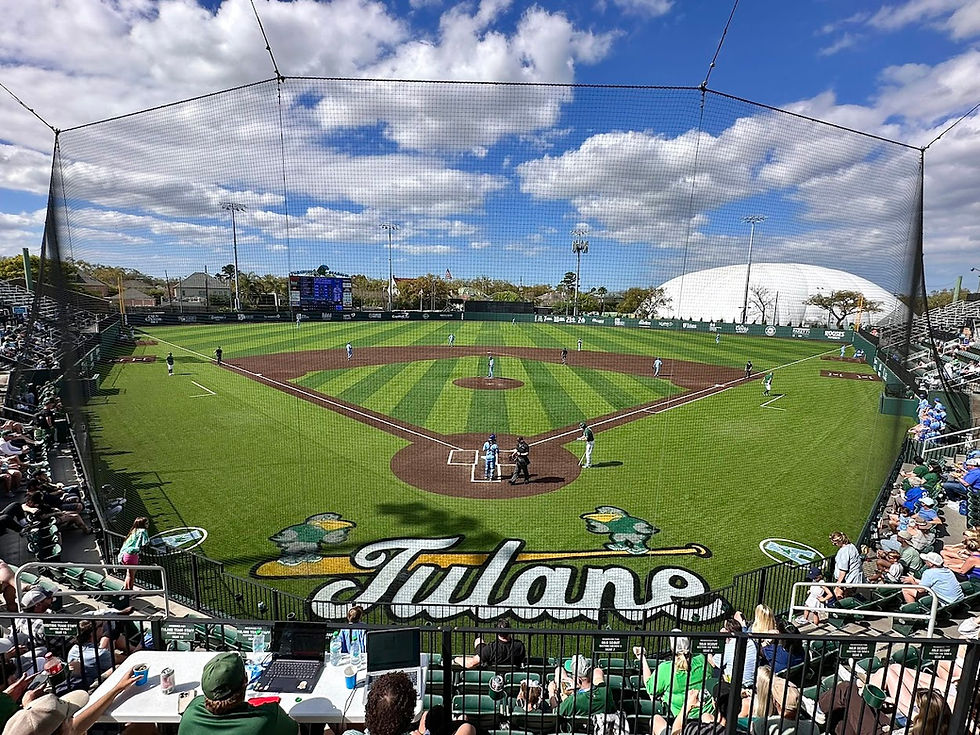
Yulman Stadium - Tulane Green Wave

Updated: Oct 12
Photos by Matt Colville, Stadium Journey
Stadium Info FANFARE Score: 4.29
Yulman Stadium Ben Weiner Dr New Orleans, LA 70118
Year Opened: 2014 Capacity: 30,000
Green Wave Roll Uptown
Tulane University’s roots in New Orleans run almost as deep as the city itself. Founded in 1834 as the Medical College of Louisiana, the school eventually became the University of Louisiana before taking the Tulane name in 1884. Football arrived not long after, with the Green Wave fielding its first team in 1893. Tulane played its first game against the Southern Athletic Club on November 18th before defeating LSU 34-0 one week later, in what is recognized as the first intercollegiate football game played in Louisiana.
From those beginnings, Tulane developed into one of the South’s early football powers. The Green Wave went 10-1 and reached the Rose Bowl in its 1931 season, captured SEC championships in 1934, 1939, and 1949, and defeated Temple in the inaugural Sugar Bowl during the 1934 season. But one of the program’s greatest seasons came much later in 1998, when head coach Tommy Bowden and quarterback Shaun King led Tulane to a perfect 12-0 record, a Conference USA championship, and a Liberty Bowl victory over BYU. The Green Wave finished the season ranked No. 7, completing the first undefeated season in program history since 1929.
Tulane football’s history is also closely tied to the history of sports venues in New Orleans. The first Tulane-LSU game was played at Sportsman’s Park, an early baseball ground in the city, before the program eventually settled into one of college football’s great old venues. Tulane Stadium opened on the Uptown campus in 1926 and soon grew from 35,000 seats to more than 80,000, earning the nickname “The Queen of the South.” There were three previous football venues on the site before the main Tulane Stadium was built in 1926.
This stadium hosted the Sugar Bowl from 1935 through 1974 and also hosted three Super Bowls, the early years of the New Orleans Saints, and some of the largest crowds in New Orleans football history, including 86,598 fans for the Green Wave’s 14-0 victory over LSU in 1973. Tulane also played its final home game here in 1974, before moving into the newly opened Louisiana Superdome the following year.
For the next 38 seasons, the Superdome served as Tulane’s home, with the exception of the nomadic 2005 season following Hurricane Katrina, when the Green Wave played designated home games throughout Louisiana and along the Gulf Coast. As impressive as the Superdome was, the cavernous NFL stadium sat several miles from Tulane’s Uptown campus and rarely provided the intimate college atmosphere the program once enjoyed. The desire to bring football back to campus eventually produced Yulman Stadium, a $73 million facility that opened against Georgia Tech on September 6, 2014. For the first time since 1974, football was played on the Uptown campus.

A decade later, that move looks even more significant. Tulane has experienced one of the strongest stretches in program history in recent years, highlighted by an American Athletic Conference championship and 12-win season in 2022, capped by a dramatic Cotton Bowl victory over USC. The success continued with 11 wins in 2023, nine in 2024, and another 11-win season in 2025, when the Green Wave captured another conference championship and reached the College Football Playoff for the first time. From the glory days of Tulane Stadium, to nearly four decades beneath the roof of the Superdome, and finally back Uptown, Tulane football has come full circle. Today, the center of that resurgence sits right in the middle of campus at Yulman Stadium.
Food and Beverage 5
One thing Yulman Stadium gets right is that the concessions actually feel like they belong in New Orleans. You can still grab the normal stadium staples such as hot dogs, burgers, pretzels, popcorn, and nachos, but also so much local flavor scattered around the concourse that there really isn’t much reason to settle for the basics. Tulane has made a noticeable effort to bring recognizable New Orleans restaurants and food brands inside the stadium, and the selection has continued to expand.
Among the highlights are Dat Dog, Blue Oak BBQ, Reginelli’s Pizza, and Superior Grill, while Plum Street Snowballs provides one of the more appropriate options for a hot September afternoon in New Orleans. Dook’s, from New Orleans chef Dook Chase, serves burgers and locally caught seafood near Section 125, while other choices include Uptown Tenders, Rizzutos, Jus Tacos, Bayou Boba, Luca Eats, and the large Hullabaloo Market. The latter is especially convenient if you just want to grab a drink or snack without standing in a traditional concessions line.
The drink selection at Yulman Stadium is just as extensive. Beer and seltzers are available throughout the stadium, along with craft beer, Guinness, frozen cocktails, margaritas, and even a Bloody Mary stand. Tulane also brought back its popular $3 beer promotion this season, with four locations around the concourse. For non-drinkers, bottled water and soft drinks are easy to find, while frozen coffee and boba give Yulman a couple of options you don't see at every college football stadium.
Prices are about what you would expect at a modern college stadium – based on the menu boards during my most recent visit, Stadium Dogs run $6.15, cheeseburgers $8.25, pretzels with cheese $6.89, popcorn $6.35, bottled water $4.25, and a 20-ounce soda $5.49. Domestic beer is listed at $9.95, with premium beer at $11.35. It isn't cheap, but the variety helps make up for it, and the $3 beer locations are a welcome exception to normal stadium pricing.
For a 30,000-seat college stadium, the sheer number of choices is impressive. More importantly, Tulane doesn't make the mistake of putting a stadium in New Orleans and filling it entirely with generic concessions. Between the local restaurants, Louisiana-inspired offerings, markets, bars, and standard fare, you could eat something different at every home game and probably still not get through everything.

Atmosphere 5
For nearly four decades the Green Wave played its home games in the Superdome, an iconic stadium that made perfect sense for the Saints, but never quite fit a small private university playing several miles away from campus. The opening of 30,000-seat Yulman Stadium in 2014 changed everything. Football returned Uptown for the first time since 1974, and with it came an actual college football Saturday. Tulane itself emphasized that bringing tailgating and football back onto its beautiful campus was central to the new stadium experience.
The setting is a huge part of it. Tulane's Uptown campus sits along St. Charles Avenue directly across from Audubon Park, with the streetcars rumbling past the front of campus. Walk through the gates and you will find historic architecture, shaded quads, and live oaks, but on game day the normally quiet lawns on campus turn into the tailgating scene. The main tailgate area near the Newcomb Quad opens four hours before kickoff, complete with tents, food, and live music, and shortly before the game the Tulane Marching Band makes its way through campus toward the stadium. Tulane doesn't have the massive seas of RVs and parking-lot tailgates you'll find at an SEC school, but that really isn't Tulane's personality anyway. This feels more like an Uptown New Orleans neighborhood party that happens to have a football game at the end of it.
Once you are inside, getting around Yulman Stadium is straightforward. The facility is essentially one compact bowl wrapped tightly around Benson Field, named after Tom and Gayle Benson, with the Uptown Terrace sitting above the east sideline. With only 30,000 seats, there really isn't a bad seat in the place. You are close to the field from almost everywhere, and when Yulman fills up the sound stays trapped inside the little bowl much better than you would expect.
The student section, green LED lighting, Angry Wave imagery, "Roll Wave" signage, and Tulane's olive green and blue give the building plenty of personality without trying to make it look bigger than it is. You'll also see Riptide, Tulane's pelican mascot, roaming the sidelines and interacting with fans throughout the game. Tulane has plenty of traditions as well, such as the Hullabaloo cheer and fight song, and even the Green Wave nickname has an interesting history, dating back to 1920 when a football song and poem titled "The Rolling Green Wave" appeared in the student newspaper, the Tulane Hullabaloo. The name caught on and eventually replaced the school's earlier nickname, the Olive and Blue.
Tulane also doesn't forget what city it's in. References to Uptown are everywhere, New Orleans music runs through the game day soundtrack, and even the marching band gets into the city's musical personality with New Orleans-flavored selections, including bounce. You'll also hear music from local staples such as Galactic, Trombone Shorty, and even Lil Wayne mixed into the presentation, which gives Yulman a character that would be hard to reproduce anywhere outside New Orleans. Tulane doesn't need 70,000 seats or a giant upper deck to create an atmosphere; Yulman's 30,000 seats, tucked onto a beautiful Uptown campus beneath old oak trees within a stone’s throw of the St. Charles streetcar, fit the Green Wave better than the Superdome ever did.

Neighborhood 5
Everybody knows there is plenty to do in New Orleans. The French Quarter and Bourbon Street are only a few miles away, and if you are coming into town for a Tulane game, chances are you’ll end up down there at some point during the weekend. But New Orleans is a lot more than Bourbon Street, and one of the best things about going to a game at Yulman Stadium is getting away from the tourist areas and spending some time Uptown.
Just off campus on Broadway is The Boot, a longtime Tulane institution that has regularly received national attention among America's top college bars. On game day weekends you’ll find it packed with students and alumni within walking distance of Yulman Stadium. Maple Street is another popular student corridor with neighborhood restaurants, coffee shops, and bars. In addition, across St. Charles Avenue from campus is the old-fashioned Frostop, a New Orleans institution known for its burgers, frosted mugs of root beer, and giant rotating root beer mug sign.
Nearby Oak Street is one of my favorite places to send visiting fans who want something that feels more like actual New Orleans. Its centerpiece is Maple Leaf Bar, a legendary New Orleans music club that has been around since 1974. If they have a show after the game, this would be near the top of my list for a visiting fan. The Oak Street area also includes restaurants, bars, and some of the quirky neighborhood businesses that make Uptown feel like a different world compared to Bourbon Street. Jacques-Imo's is one of the neighborhood's most popular restaurants, while Snake & Jake's Christmas Club Lounge is one of New Orleans' great late-night dive bars, tucked inside a tiny building and covered in Christmas decorations year-round. Or, if you're looking for more live music without venturing into the French Quarter, check out Tipitina's, the world-famous music venue on Napoleon Avenue that has been a New Orleans staple for decades.
Another New Orleans tradition worth experiencing is the sno-ball, which was actually invented in New Orleans. One of the best places to try one is Plum Street Snoballs, located just a short distance from Tulane on Burdette Street. This little neighborhood stand has been serving sno-balls since 1945, and is a longtime favorite among Tulane students and Uptown residents.
On the other side of campus is Audubon Park, whose live oaks, walking paths, and golf course sit directly across St. Charles Avenue from Tulane’s campus. Continue through the park toward the Mississippi River and you'll eventually reach Audubon Zoo and The Fly, a popular riverfront gathering spot behind the zoo. Magazine Street runs along this side of Uptown as well, stretching for roughly six miles through some of New Orleans' best neighborhoods. However, this area is filled with independent shops, vintage stores, bars, coffee shops, and restaurants rather than the souvenir shops you encounter downtown. In fact, you'll encounter a restaurant or small local shop on practically every block of Magazine Street.
Then there is St. Charles Avenue itself, which runs directly in front of Tulane University and may be one of the prettiest approaches to any college campus in the country. Massive live oaks shade the neutral ground, stately old New Orleans mansions line the street, and the streetcars rumble right past campus on their way through Uptown and the Garden District toward downtown. You can legitimately attend a football game at Tulane without ever getting into an automobile; stay somewhere along the streetcar line, ride one of them Uptown, get off in front of campus, and walk over to Yulman Stadium.
Fans 4
Tulane has a loyal fanbase, but it is a little different from what you'll find at most southern college football programs. This is a small private university in a city with an NFL team, and for years the Green Wave struggled to draw much of a crowd playing in the Superdome. Moving back to campus has helped bring some of that college football atmosphere back, especially with the program's recent success. Today’s football crowd is a mix of longtime Tulane supporters, alumni, students, and locals who have followed the Green Wave for decades. Tulane also has a large medical school, and plenty of its graduates, including doctors working around the New Orleans area, remain connected to the university.

The student section occupies the south end zone and is one of the more noticeable parts of the Yulman experience. At kickoff this section is usually packed with students dressed in green and blue, many of whom have spent the afternoon tailgating around campus. The students stand throughout much of the game, get loud on third downs, and help give the small stadium some energy. One thing I noticed, however, is that this section tends to thin out considerably as the game goes on. By the second half, many students have already headed for the exits, even while the rest of the fans in the stadium remain engaged in the game.
The most recognizable Tulane tradition is the Hullabaloo cheer, which dates back generations and is still heard throughout Yulman Stadium, particularly after Green Wave scores. Fans also join in the familiar "Roll Wave" chants, while the marching band plays the Tulane fight song and alma mater. Riptide, the school's pelican mascot, makes his way around the stadium interacting with fans, and the cheerleaders help keep the crowd involved. The atmosphere here is a nice mix of older traditions and the more modern New Orleans flavor that has become part of the Yulman game day experience.
Tulane fans have stuck with this program through some pretty lean years, and the recent run of winning seasons has given them plenty to cheer about. The crowds are generally friendly so visiting fans shouldn't have any problems, and when the Green Wave is playing well, Yulman can get really loud for its size. Tulane has come a long way from the days of playing in front of scattered crowds inside the Superdome, and its fans finally have a stadium that feels like their own.
Access 3
If there is one downside to attending a Tulane game, it might be getting to Yulman Stadium in the first place. New Orleans isn't exactly the easiest city to navigate, especially if you aren't familiar with the streets, and unlike the Superdome, which sits right off the interstate with several parking garages nearby, Yulman is tucked away in a residential neighborhood with limited parking and narrow streets.
If you're coming from the French Quarter or downtown, your GPS may take you down Claiborne Avenue and through some of New Orleans' rougher neighborhoods before bringing you right up to the football stadium. This is generally the more direct route, but if you have extra time, I recommend taking St. Charles Avenue instead. It's a much prettier drive, passing through the Garden District and Uptown beneath massive live oaks, with historic mansions and the famous St. Charles streetcars running down the middle of the avenue.
Another option is to take the St. Charles streetcar. The streetcars run from the French Quarter or CBD through the Garden District and Uptown before stopping directly in front of Tulane's campus. From there, it's about a 10 to 15-minute walk to Yulman Stadium. At $1.25 for a one-way ride, it's also an affordable way to avoid parking. Just keep in mind that the streetcars aren't particularly fast and can get crowded on game days.
Parking is probably the biggest headache at Yulman Stadium. Tulane doesn't have the sprawling parking lots you'll find at most college stadiums, and much of the surrounding area is residential. There are two parking garages nearby, including the Loyola parking garage near the basketball arena, although football game day availability varies. Expect to do some walking, but fortunately, the walk through Tulane's beautiful campus, past historic buildings and towering live oaks, is one of the more enjoyable parts of the experience.
One thing that may catch first-time visitors off guard is the entrance setup. If you're approaching from the south side of campus, the main security checkpoint is located roughly 100 yards outside the stadium near the campus recreation center. Bags are checked and tickets are scanned there, before fans continue toward Yulman.
Once inside, getting around is fairly straightforward thanks to the stadium's small size. The only real issue is that some concourses are narrow, and concession lines can back up into the walkways, especially around halftime.
Yulman Stadium is a great place to watch football once you get here, but getting in and out requires a little planning. Between the Uptown traffic, limited parking, and occasional concourse congestion, access is one of the stadium's weaker areas. My advice is to arrive early, take the scenic route down St. Charles Avenue, or better yet, hop on the streetcar and enjoy the walk through campus.

Return on Investment 4
Tickets to Tulane games are generally affordable, with upper-level seats often available for around $20 to $30, although prices vary depending on the day’s opponent. Concession prices are a little on the high side, but the variety of local New Orleans food makes up for it. For the full New Orleans experience, hop on the St. Charles streetcar and ride it Uptown to Tulane. On your walk to Yulman Stadium, make sure to stop by the Mardi Gras Bead Tree, where thousands of colorful beads hang from the branches, left behind from years of Mardi Gras celebrations. Once inside, enjoy some Tulane football with the marching band playing New Orleans funk and bounce music throughout the game. Afterward, walk over to The Boot just off campus for a drink, then head down to Oak Street for a po-boy at Jacques-Imo's before catching some live New Orleans music next door at the legendary Maple Leaf Bar. Between the streetcar, Mardi Gras beads, local food, live music, and college football in the heart of Uptown, you really can't beat a Saturday at Tulane.
Extras 4
An extra point goes to the history surrounding Yulman Stadium. The facility and surrounding grounds occupy part of the former site of Tulane Stadium, once known as the "Queen of Southern Stadiums." That historic 80,000-seat stadium hosted the Sugar Bowl, the Saints, and three Super Bowls in 1970, 1972, and 1975. It's pretty cool knowing you're walking on ground where some of the biggest games in football history took place.
Another plus goes to Caesars Superdome, Tulane's former home from 1975 to 2013. From the upper deck at Yulman Stadium you can get some excellent views of the Superdome, as well as the New Orleans skyline in the distance.
Inside Yulman, the concourse features historical murals celebrating Tulane football, including the undefeated 1998 team and the memorable 14-0 win over LSU in 1973. You'll also find remnants of old Tulane Stadium, the Tulane-Southern Miss rivalry bell, and the Green Wave's 2025 American Conference championship trophy.

A final point goes to Tulane's beautiful Uptown campus. Between the historic architecture, shaded quads, massive live oaks, the Mardi Gras Bead Tree covered in colorful beads, and the St. Charles streetcars rolling past campus, there aren't many better settings for college football.