


Spartan Stadium Name for Sale and $500 Million Revamp
Updated: May 14

Rendering Courtesy of Michigan State University
Spartan Stadium, the iconic home of Michigan State football since its opening in 1923, is poised for the most ambitious renovation in its century‑long history. Athletic Director J. Batt told the Detroit Economic Club on May 5 that, if fundraising and approvals stay on schedule, the stadium will be “freshly renovated” by fall 2029. The overhaul, estimated at $500 million, will focus on the aging east side, upgrade fan amenities, and explore new revenue streams such as naming rights, hotels, and premium seating.
Why the Upgrade is Needed
Aging Infrastructure – After nearly 100 years, structural components on the east side show significant wear.
Attendance Challenges – The Spartans have posted four consecutive losing seasons, leaving the 74,866‑seat venue partially empty late in the fall.
Competitive Landscape – Peer institutions such as Penn State and Ohio State are continuously modernizing to attract recruits and donors.
“It's not more seats, it’s better seats,” Batt emphasized, highlighting a shift toward premium experiences that can command higher ticket prices and corporate partnerships.
Funding and Timeline
December 2023: Greg and Dawn Williams pledged $401 million, with $290 million earmarked for the university’s broader FOR SPARTA $1 billion capital campaign.
Projected Cost: Roughly $500 million for the stadium portion, including demolition, structural upgrades, and new hospitality spaces.
Construction Window: Groundbreaking slated for fall 2027; completion targeted for summer 2029.
Season Continuity: The Spartans will continue to play at Spartan Stadium during construction, employing temporary seating and phased work similar to Penn State's recent stadium remodel.
Planned Features:
Premium Seating - New club level suites, loge boxes, and reconfigured general‑admission sections with wider seats and better sightlines.
Technology Upgrades - Enhanced Wi‑Fi, LED lighting, and an expanded high‑definition video board (the current board was installed before the 2022 season).
Hospitality & Entertainment - Up to four new restaurants, a hotel adjacent to the stadium, and expanded concessions featuring local cuisine.
Student Housing - New on‑campus residences near the stadium to boost student engagement on game days.
Naming Rights - Exploration of a stadium naming partner, a move that could add tens of millions in long‑term revenue.
IM West Demolition - The aging IM West building will be removed, freeing a sizable parcel for the new mixed‑use development.
Beyond Football: A Campus Magnet
University President Kevin Guskiewicz framed the project as more than a sports renovation. “We want to create something really special, a magnet where people want to just come to campus,” he said, noting that the current Kellogg Center looks “tired.” The envisioned campus hub would integrate dining, lodging, and entertainment, extending revenue generation well beyond the football season.
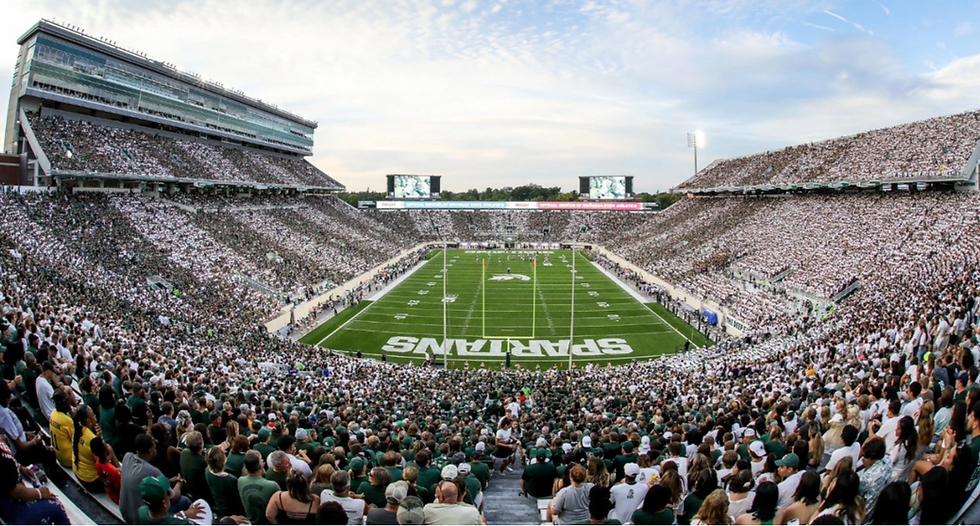
Photo courtesy of Michigan State University athletics
Market Context
College athletics revenue has surged in the past decade, driven by media rights, donor gifts, and commercial partnerships. According to the NCAA’s 2023 revenue report, the top 25 football programs collectively generated over $10 billion in total revenue, with stadium naming deals accounting for an average of $25 million to $40 million annually. Michigan State’s pursuit of naming rights aligns with this trend and could help offset construction costs while enhancing brand visibility.
Challenges Ahead
Fundraising Gap – Even with the Williams donation, an additional $100 million, and $150 million will be needed to fund the stadium portion fully.
Board Approval – The university’s Board of Trustees must sign off on the master plan, demolition of IM West, and any naming‑rights agreement.
Construction Logistics – Phasing work to avoid disrupting home games will require meticulous scheduling and may limit certain upgrades in 2028.
Batt remains confident: “We’re open for business,” he said, emphasizing a careful vetting process for any corporate partner to preserve the “hallowed ground” of Spartan Stadium.
What It Means for Fans
Short‑Term: Expect limited seating adjustments during the 2028 season as construction ramps up.
Long‑Term: A modernized arena with premium lounges, improved connectivity, and an on-site hotel that could host tailgate parties, concerts, and other events year‑round.
Spartan Stadium’s transformation promises not only to revitalize a historic venue but also to position Michigan State as a leader in the evolving economics of college sports. If the project stays on track, fans will experience a markedly upgraded game‑day atmosphere by the 2029 fall season, while the university taps new revenue streams to sustain its athletics and academic missions for decades to come.


