Clemson's Death Valley History (2009 - Present)

The day in 2007 the student body's passionate roars put Memorial Stadium in the Guinness Book of World Records showed the incredible devotion and hunger Tigers fans still had, despite their recent lack of major success. These fervent Clemson fans deserved a program that could match their passion with wins. Then the Clemson Tigers hired Dabo Swinney.
Dabo Swinney’s Bringing Clemson and Memorial Stadium into the Modern Day!
Swinney’s tenure didn’t start with an instant return to the top of the ACC. But he gave the program something it had been severely lacking for decades: consistency. He strung together multiple bowl game appearances in a row and even ended the 2009 season ranked in the top 25.
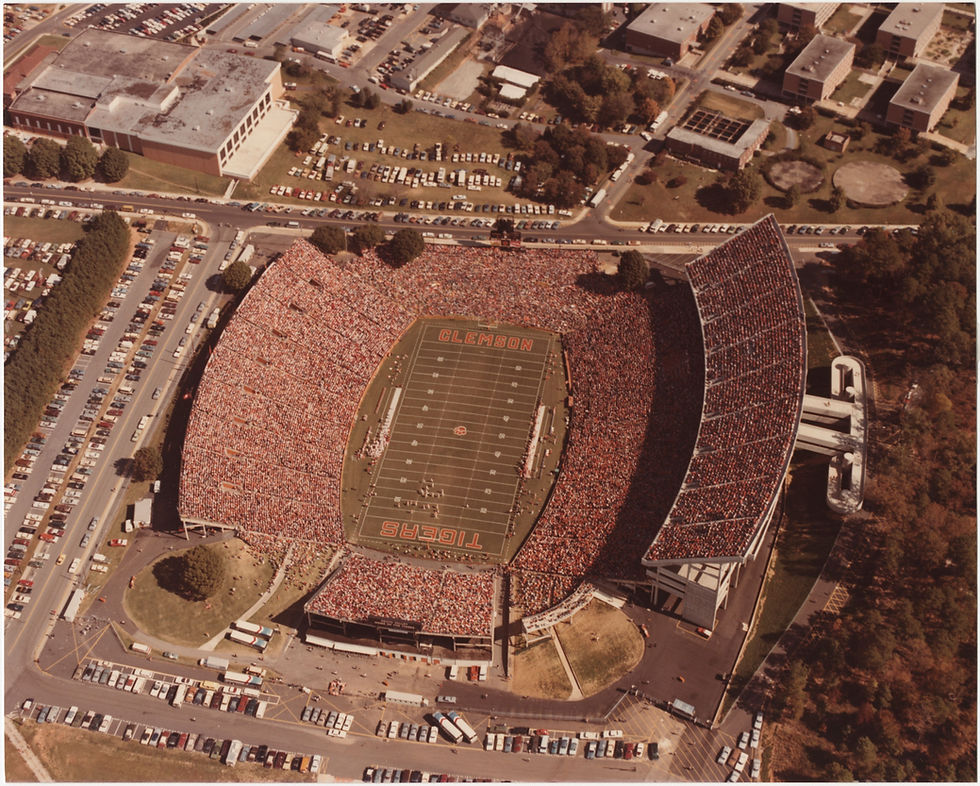
But of course, the Clemson brass wanted far more, so they began an ambitious plan to return to the top rank of college football, continuing renovations to its infamous Memorial Stadium. They ended 2009 ranked, in part, because they started the second phase of the WestZone project that year. The project transferred many of the resources from the McFadden Building (an athletics administration building), like all the football offices and team meeting rooms. It added dedicated football training and strength conditioning facilities, and increased the spectator capacity to 86,000, making that Death Valley crowd that much more intimidating to any conference foe or all-time rival who had to step foot in Memorial Stadium.
2010 would also give the now long-standing stadium a new momentum that honored the legacy of the stadium and those Clemson heroes after whom the stadium was named. Built in 1942, in the middle of WW2, Memorial Stadium was named in honor of "all Clemson men who have made the supreme sacrifice for their country." And in 2010, the program would honor those fallen heroes with the Scroll of Honor. A memorial to 498 known men and women who sacrificed their lives for their country, showing incredible bravery and honor in the face of ultimate adversity. It was dedicated by The Clemson Corps, on April 22, 2010. A fly past of two T-34B Mentors concluded the ceremonies.
"We found documentation in the archives at The Strom Thurmond Institute, yet there was no manifestation of that purpose anywhere around the stadium," Rhodes, co-chairman of the committee that has overseen the memorial, said. "So it was natural for us to pick that location. What greater way than to honor the supreme sacrifice and have that memorial across the street.”
"That's prime property, as you can well imagine. But we got the full support of the athletic department, full support of the alumni association, the campus planning office, and the administrative council because they saw that tremendous link between the location and the purpose for naming the stadium."

With Clemson now closer to tradition and bonded together, bolstered by those who went through tragedy to keep the stadium and the school still standing, the university went all in on blistering the program to higher heights than it’s ever been, spending every penny they had to do so.
On January 14, 2011, Clemson University announced its plans for a $50 million athletic building plan, which would include the completion of the WestZone project and a brand-new indoor practice facility. It was designed to stand out as one of the nation's best. State-of-the-art resources like a regulation-size artificial turf football field, a coach's tower, and video platforms, costs $15 million bucks to make Clemson a national power again.
“The indoor practice facility will be a highly significant addition for Clemson, not only for football but also for other sports to use,” Phillips said. They also added the oculus which serves as the entrance to the WestZone and features a four-level museum.
Following the completion of the northwest concourse WestZone expansion, Clemson made their first major bowl game in decades, the 2012 Orange Bowl to face West Virginia. And while the 70-33 loss is not a happy memory for any Clemson fan, it was the start of greater things to come, for both the program and the stadium.
In their return to the Orange Bowl, Clemson would be redeemed by beating Ohio State 40-35. And two seasons later, Dabo Swinney would win his second ACC title as Clemson’s head coach, and that same 2015 season almost returned Clemson to the top rank of college football. They made the national championship game for the first time in the modern era!
It would end in another heartbreaker as they lost 45-40, but they’d redeem themselves again two years later. The Clemson Tigers took on the evil empire of Alabama once again in the National Championship game in another nail-biter of a game. But this time it would be Clemson winning by four points, 35-31, clinching their first National Championship since 1981.
Surprisingly, during this time, not a lot of work was done on Memorial Stadium, allowing Death Valley stand proudly on its own as it took part in many of the most-watched college football games of the year. But in Clemson’s usual spirit of innovation, that wasn’t going to last long.
In 2016, Clemson approved a brand-new football complex right by the practice facility and Memorial Stadium, and construction began in 2017. The $55 million project included a 140,000-square-foot building containing meeting rooms, new areas for students to hang out, and for players to visit after practices and games. With an indoor replica of the Hill and Howard’s Rock, the facility includes a career development and leadership center, a players’ lounge, locker rooms, training/rehab facility, weight room, nutrition center and dining facility, meeting rooms, coaches’ offices, and a recruiting war room.
“We are very excited and appreciative about this new day-to-day home of our program,” said Coach Dabo Swinney. “This complex will be one of the best in the nation and will allow us to continue our pursuit to be among the best programs in the country. We look forward to it being the home of Clemson football for a very long time.”
Coach Swinney describes the new complex as the “epitome of Clemson: fun, special, and the best in the country.”
“This project will be a huge step forward not only for our football program but for each of our sports,” Director of Athletics Dan Radakovich said. “We’ve begun studies on how best to utilize the WestZone to most effectively impact each of our student-athletes, and we sincerely appreciate the support of IPTAY and all of our donors who will make this new complex a reality.”
There was still more to come for both Death Valley and the Clemson Tigers football team. In 2017, Clemson won its third straight ACC championship on its way to clinching a playoff spot and a trip to the Sugar Bowl.
There, they lost to rivals Alabama 6-24, but as they have a tendency to do, the next year they came back with vigor. Winning a fourth straight ACC title en route to making the playoffs. They defeated Notre Dame in the Cotton Bowl to earn another trip to the National Championship game to face their worst enemies, Alabama, yet again. Responding to their 2018 blowout with a more emphatic blowout of their own, they defeated the Crimson Tide 44-16.
With a third National title came more renovations to Memorial Stadium, approved by the board of trustees. The $60 - $70 million project was aimed to be completed by 2021. It encompassed an upgraded state-of-the-art 50+ ft expanded video board, new lighting and sound systems, a West Concourse Club addition, and a Field Level Club. A new campus-facing entry, with additional seating in the east part of this brand-new entrance. The parking was reconfigured, and the locker rooms were expanded. Accessible seating was doubled in the lower deck, while 130 new seats were added.
This marked the first major upgrade to the stadium since the launch of the WestZone project in 2006, and the Tigers delivered in a big way. They rewarded the fan base and community with their fifth straight ACC championship and Dabo Swinney’s sixth overall. They followed it up with a Fiesta Bowl victory before falling in another National Championship matchup, this time to the legendary 2019 LSU team led by Joe Burrow in the clash of the Tigers.
This is where the National Championships begin to dry up for now, but despite that, Clemson is still dominating the ACC, and the Memorial Stadium is still being approved upon with the completion of the 126-foot Dabotron. Named after the most successful coach in Clemson’s history, this jumbotron has high-quality LED field lighting, which displays high-quality special effects. Other upgrades include 688 premium seats for a new master club on the west concourse level and a new field-level club on the west side. They updated the Tiger Walk (a pregame tradition where fans line up to cheer on the football team as they arrive at Memorial Stadium) with brand-new landscaping and lighting for use all year.

Memorial Stadium has become much more adaptable over the years. In 2025, Memorial Stadium played host to the Savannah Bananas baseball team. That required 50-foot-high netting and field changes, which operations crews set up and rolled back with little trouble.
Memorial Stadium has hosted several major concerts over the years, including the Rolling Stones’ 1989 stop on the Steel Wheels/Urban Jungle Tour, with Living Colour serving as the opening act. It hosted Pink Floyd in 1994 for The Division Bell Tour and Elton John with Billy Joel in 1995 for the Face to Face 1995 tour. The Eagles played there in 1996, and in 1997, the stadium welcomed U2, with Rage Against the Machine, for the PopMart Tour. Chiddy Bang even had a Clemson University homecoming event shut down by the police.
Since their last trip to the National Championship, Clemson football has added three more ACC titles - 2020, 2022, and 2024 - with Dabo Swinney still in charge. The Tigers is far from the heights it reached less than a decade ago, the program remains strong.

Clemson’s investment in football, and the sport’s importance to the identity of the university, all but guarantees that any downturn is temporary. Nowhere is that commitment more visible than at Memorial Stadium.
Millions of dollars have gone into keeping Death Valley one of the most intimidating environments in college football. With a 76 percent all‑time win rate and one of the largest stadiums in the country, Memorial Stadium is built for great moments - and many more are still to come.