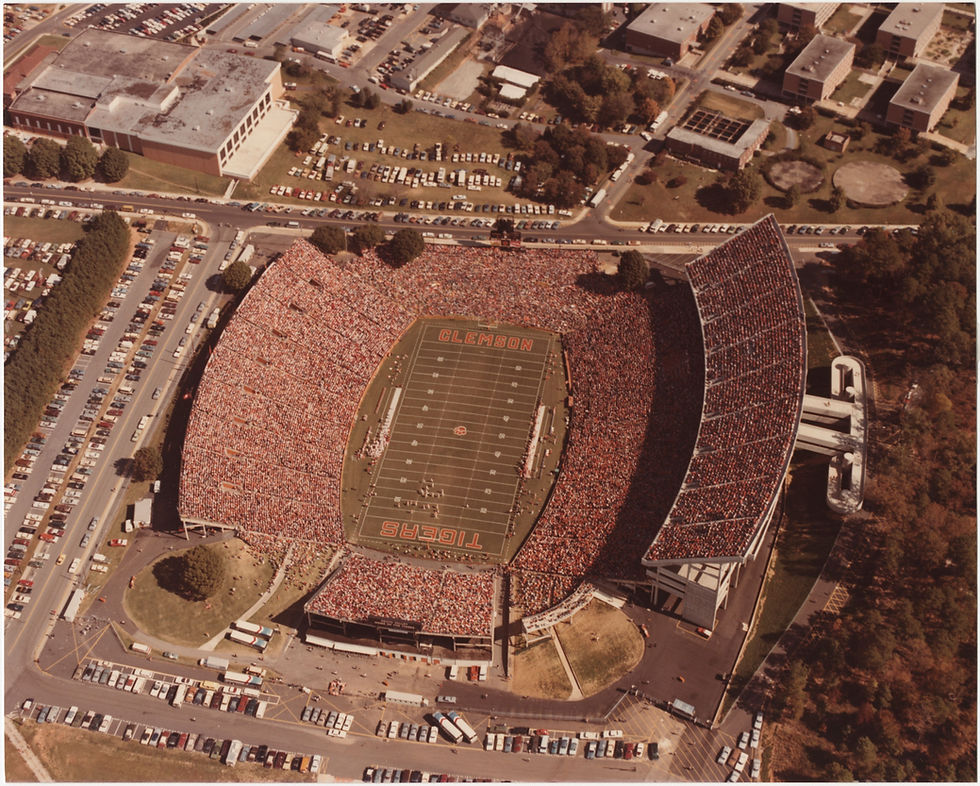
Clemson's Death Valley History (1942 - 1972)
Not everyone was a fan of building a new stadium for the Clemson Tigers football team. The most outspoken and notable critic, Clemson’s Jess Neely (head coach at the time), said, "Don't ever let them talk you into building a big stadium. Put about 10,000 seats behind the YMCA. That's all you'll ever need," shortly before he left to coach Rice University in Texas in 1939.
However, that only made things easier for Clemson University, which decided to replace the old Riggs Field in 1939 and build a brand-new stadium in the valley by the western part of campus, and called it Memorial Stadium.
Before Memorial Stadium, Clemson had only five conference titles and zero national titles. Since building Death Valley (as it is affectionately nicknamed), they’ve won 23 conference titles and have claimed three national championships. Thank goodness they didn’t heed Neely’s word then.

Memorial Stadium’s early days!
The brand-new stadium was broken into as well as it could’ve been as the Tigers football team had a comfortable time beating Presbyterian College in a 32–13 rout. And that wasn’t the only blood, sweat, and tears the student-athletes gave to help promote this stadium, because many of them literally helped build the stadium itself.
Yes, many of the student-athletes at Clemson would help build Memorial Stadium, including many of the football players who went on to be the very first players to ever play there. That made the 20,000-seat stadium the longest-lasting legacy and proof of their athletic prowess, hard work, and passion for the university.
But of course, they’d have nothing to build if nobody designed the stadium for them. Those designers were Carl Lee, H.E. Glenn, Hugh Webb, and A.N. Cameron, who started the tradition of the team running through the east side hill because it was the most affordable way to build the stadium at the time. This began a long-standing tradition to save a few bucks.
Construction was a lot rougher than the debut game was. One afternoon, while the workers were clearing plants, one of the student-athletes claimed he wasn’t allergic to poison oak and began attacking the poison oak. The next day, he had swollen to twice his size and was hospitalized. This was far from an isolated incident. Due to the manual labor and tiresome work effort, after the seeding of the grass, 40 people would lie on the grass to rest. They were only halfway through after three weeks, and Frank Howard, ever the innovator and leader, found a way to speed up the process.
“After three weeks on July 15, we had only gotten about halfway through. I told them that it had taken us three weeks to get that far, and I would give them three more weeks’ pay for however long it took to finish. I also told them we would have 50 gallons of ice cream when we got through. “After that, it took them three days to do the rest of the field. Then we sat down in the middle of the field and ate up that whole 50 gallons.”
Frank Howard would go on to establish Clemson as an ACC football powerhouse. Starting in 1948, Frank Howard began creating his legend and building up the Clemson Tigers football program, winning his first-ever bowl game, beating Missouri by a single point in the 1949 Gator Bowl.
It didn’t take long after that for the Tigers to hit the big time. Being invited to the two Orange Bowls and a Sugar Bowl in the 50s, along with winning their first of many ACC conference titles in 1956. Even beating Miami (FL) in their first-ever Orange Bowl trip, beating them by one point.
This kind of success deserved a reward, and that’s exactly what the university gave them with the coining of their iconic Death Valley nickname. The iconic stadium earned this nickname in 1948 after Presbyterian College’s football coach stated that he had "to take his team up to Clemson and play in Death Valley." (Presbyterian College was the first university to play the Clemson Tigers at Memorial Stadium.) Frank Howard ran with this nickname and frequently spoke to the media, calling their stadium Death Valley during Clemson’s 1950s success run. And, the name also made geographic sense, as the stadium was built near the location of the Clemson University cemetery on a hill that once overlooked the field, before the upper decks were constructed.
In 1958, the university added 18,000 sideline seats near the end zone, which covered up the graves that once scarred Presbyterian College and many other teams. This was followed up quickly with a 5,658 west end zone seating expansion in 1960, due to the rising attendance and demand for tickets to Clemson games. This expanded Death Valley’s seating capacity to 53,000 even as the team hit a lull in the early 60s.’
Despite that, another proud Clemson tradition started during this time. That being that of Howard’s Rock. One that plays into the Death Valley nickname. As a friend of legendary coach Frank Howard, Samuel Columbus Jones (Clemson Class of 1919) presented the rock to Howard with Jones saying, "Here's a rock from Death Valley, California, to Death Valley, South Carolina." Despite the heartfelt gift, Howard didn’t see much in it.
Using it as a doorstop for years before telling the IPTAY (a member-based organization that supports Clemson student athletes), executive director Gene Willimon, "Take this rock and throw it over the fence or out in the ditch...do something with it, but get it out of my office." But whether Willimon wanted to repay Jones’ kindness properly or saw the impact it could have on the team, instead of throwing it in a ditch, in 1966, he had the rock placed on a pedestal at the top of the east end zone hill that the team ran down to enter the field for games.

The first game where the players ran that famous tunnel and by the rock, they beat conference foe Virginia, 40–35. Howard is ever the motivational opportunist, and then he told the whole locker room. "Give me 110% or keep your filthy hands off of my rock." The first time Clemson players rubbed their hands on Howard’s Rock, they lived up to their implied promise and gave it 110% to a weak Wake Forest 23-6. Thus starting a tradition that has lasted generations.
But what started in 1960, Clemson began a near two-decade long absence from any bowl games, halting any expansion to Death Valley. But even during this time, Clemson was still racking up ACC titles under Frank Howard. They earned a three-peat as ACC champions from 1956 to 1967, with all their wins in 1966 and 1967 being in conference.
The Death Valley crowd was a huge part of this run. In those seasons, Clemson went 10-4 at Memorial Stadium, playing many of their ACC games at home, even upsetting #10 North Carolina State in 1967. Frank Howard left the house he built, which was later named after him in 1969. After the departure of such an influential figure, Clemson failed to find their previous success. So, it was time to modernize, starting with Memorial Stadium. In 1972, the original cedar wood seating was replaced by aluminum seats.